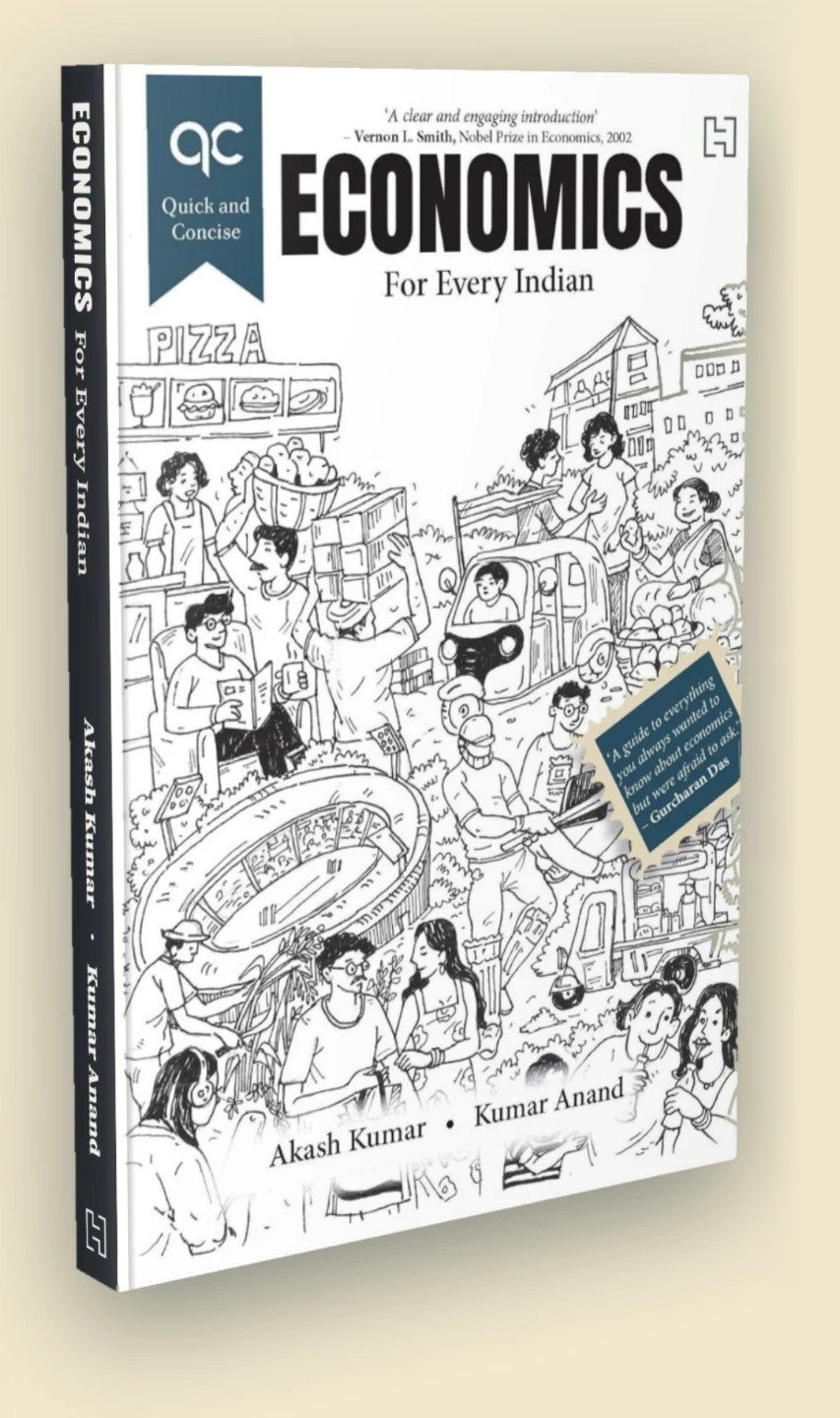
Nice try. This one’s a Chapter 5 exclusive, and we’re not giving it away for free. The answer costs ₹499, or maybe less if you’re in luck and Amazon has a discount on. Get the book →
In this disarming and playful guide, Akash Kumar and Kumar Anand strip economics down to its essence. Zero jargon and (almost!) no graphs — and by the end, you’ll never read the news the same way again.

Like talking about paper leaks, petrol prices, freebies, onion prices, or “why is this country still so poor”?
Economics for Every Indian hands you the toolkit to actually understand the arguments behind these issues. In eight short, funny and jargon-free chapters, Akash Kumar and Kumar Anand show how prices talk, why nations rise and fall, and what the government has any business doing.
By the end, you’ll never read the news the same way again.
More praise for the book
Read a few pages
Pause and think
Chapter 2 · Comparative advantage
More Cricket, Less Chores – a Challenge
Adithya and Prashanth are teenage twins who live with their parents in Bengaluru. Every Sunday evening, they have to do household chores – laundry and dishes – and that too when IPL matches are telecast on TV.
Here’s the thing: Adithya is simply faster at everything. He can finish ironing his shirts in 30 minutes and washing his dishes in 60 minutes. The younger Prashanth takes 120 minutes to do the ironing and 90 minutes to do the dishes.
None of them wants to miss seeing Virat Kohli bat. Prashanth has a lightbulb moment. ‘Bro,’ he says to Adithya, ‘what if we trade our chores?’
Adithya laughs. ‘Maga, I’m faster at everything. How would this help?’
Pause and think: Before reading on, can you solve their puzzle? How can both brothers save time?
Decide who does each chore. Can both brothers get to the TV sooner?
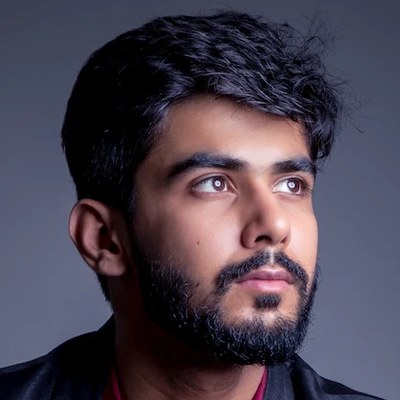
Akash Kumar grew up in Motihari, Bihar. When he spent a school year in the United States as part of the KL-YES Programme of the US Department of State, he could not stop asking why some places stay poor while others get rich. That question never left. He studied at IIT Madras, led academic programmes for Students For Liberty across South Asia and had a short stint working with the Chief Minister’s Office of Maharashtra. He has written for Hindustan Times, Deccan Herald and News18, among others. Today he is co-founder and CEO at Raaz MD. When not building Raaz or arguing about economic policy, he is usually hunting for a good cup of specialty coffee.
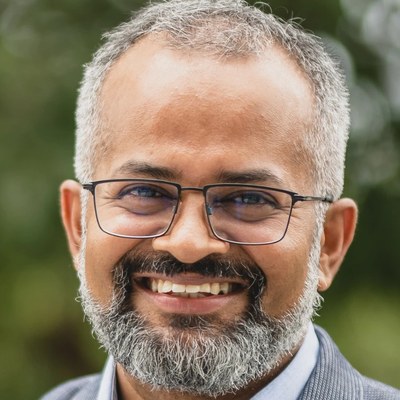
Kumar Anand grew up in Saharsa, Bihar. It might explain why two people from small-town Bihar ended up writing a book about why prosperity is so unevenly distributed. Kumar is an economist and public policy professional with over fifteen years of experience working on questions of Indian economic growth, economic history and public policy at organizations including Asianomics Limited, the National Institute of Public Finance and Policy, Free A Billion and the Centre for Civil Society. He has written for publications including The Hindu, Rajasthan Patrika and the French weekly Le Point. He studied economics at the University of Delhi and the Gokhale Institute of Politics and Economics, Pune.
We wrote this book because we believe that change would only come through a change in ideas we believe in as a society. It begins when you pause to ask: ‘But what about the unseen?’ Because economics, really, is the art of seeing what most miss.